What the Sri Lanka ETA actually is, who gets it free since May 2026, real current fees, and the separate Digital Arrival Card step that's easy to miss.
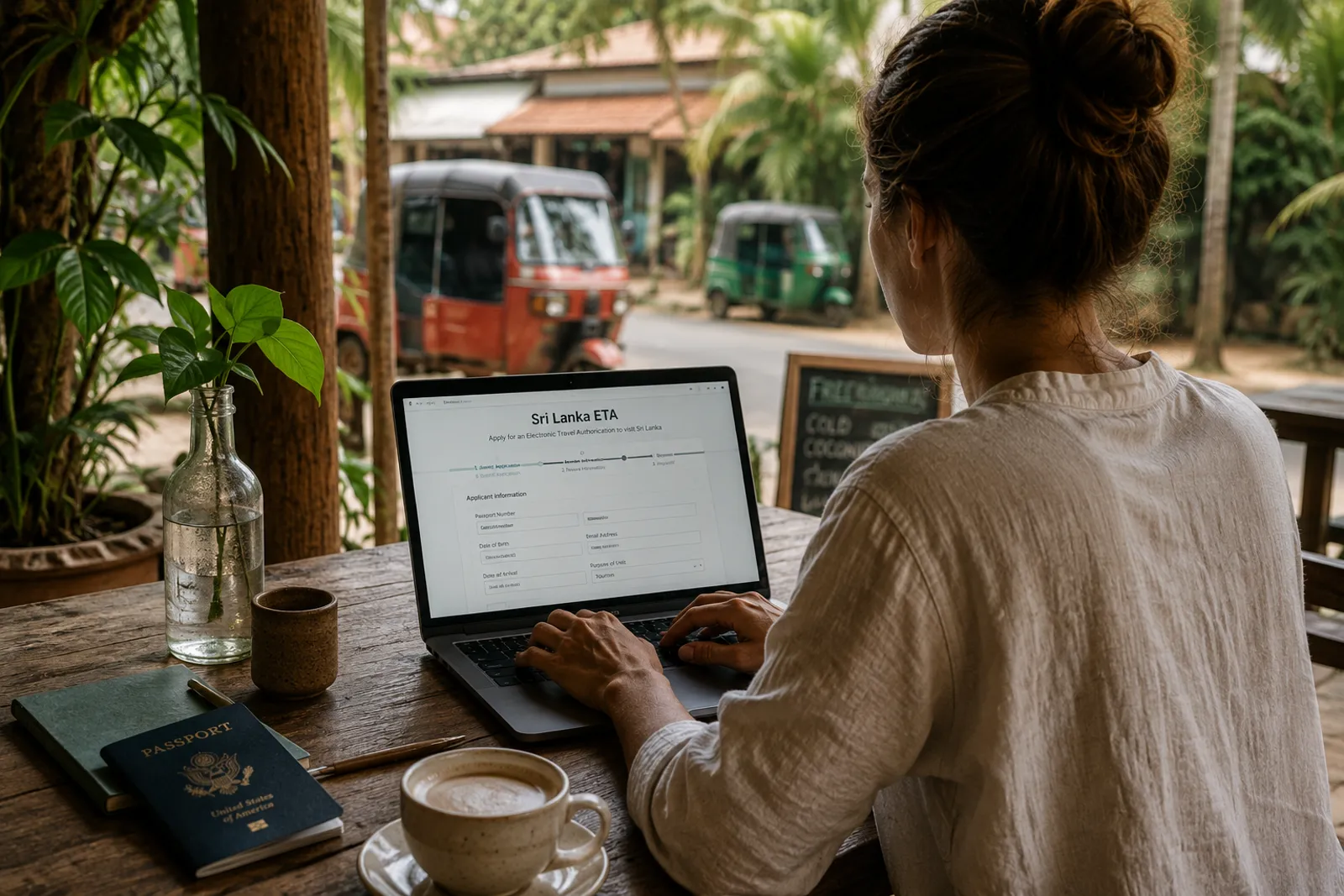
Since 25 May 2026, nationals of 40 countries (including the US, UK, most of the EU, Australia, Canada, Japan, China and India) get a 30-day tourist ETA for free. Everyone else pays US$50 online for a tourist ETA or US$60 on arrival — plus a separate, unrelated Digital Arrival Card that almost every guide forgets to mention. Both are required. Neither is a visa-on-arrival stamp. Apply for both directly: ETA at eta.gov.lk and the Digital Arrival Card at eservices.immigration.gov.lk.
For years, Sri Lanka’s entry system was a genuine mess of conflicting advice: visa-on-arrival for some, e-visa for others, paper forms nobody could find twice. Since October 2025, that’s gone. Almost every foreign arrival now needs an Electronic Travel Authorization (ETA), applied for before you fly, through one official channel: eta.gov.lk.
The bigger change lands on 25 May 2026: nationals of 40 countries stop paying for it entirely. If you’re travelling on a passport from Australia, Austria, Bahrain, Belarus, Belgium, Canada, China, Czech Republic, Denmark, Finland, France, Germany, India, Indonesia, Iran, Israel, Italy, Japan, Kazakhstan, Kuwait, Malaysia, Nepal, Netherlands, New Zealand, Norway, Oman, Pakistan, Poland, Qatar, Russia, Saudi Arabia, South Korea, Spain, Sweden, Switzerland, Thailand, Turkey, UAE, the UK or the US, your 30-day tourist ETA costs nothing. Singapore and Seychelles nationals get the same free 30 days under separate reciprocal agreements, and Maldivians get 90 days free.
If your passport isn’t on that list, the ETA still isn’t optional — you just pay for it.
This is the current Sri Lanka visa fee schedule, taken directly from the official ETA fee page — worth bookmarking so you can check it yourself before you pay anyone:
| Category | South Asian (SAARC) countries | All other countries |
|---|---|---|
| Tourist ETA — applied online, before travel | US$20 | US$50 |
| Tourist ETA — applied on arrival | US$25 | US$60 |
| Business ETA — applied online, before travel | US$30 | US$55 |
| Transit ETA (2 days) | Free | Free |
A few things worth knowing that the table doesn’t say on its own: children under 12, of any nationality, get a free 30-day tourist ETA. And applying online before you fly is always cheaper than doing it on arrival — for non-SAARC travellers, that’s a $10 difference for showing up prepared.
India is on the free list — this is the single most-searched version of this question, and the answer has changed recently enough that a lot of what circulates online is out of date. Before 25 May 2026, Indian nationals paid the SAARC tourist ETA fee ($20 online, $25 on arrival). Since that date, Indian passport holders get the same free 30-day tourist ETA as UK, US, and EU travellers — you still submit the application at eta.gov.lk and still need the separate Digital Arrival Card, you just aren’t charged for the ETA itself. If you’re finding older guides quoting a SAARC fee for Indian travellers, or referencing a “visa on arrival” process from before the ETA system existed, that advice predates this change.
The ETA is your Sri Lanka travel authorization — it’s what lets you board the flight and enter the country. It is not the same as the Digital Arrival Card, a separate requirement introduced in 2023 that captures your arrival details (flight, accommodation, health declaration) and can be completed up to 3 days before you fly through the Department of Immigration’s e-services portal. Having a valid ETA does not exempt you from it, and having filled in the Digital Arrival Card does not substitute for the ETA. You need both, and they’re submitted through different systems. If you land at Bandaranaike International, near Negombo, immigration staff will ask for both.
If your stay needs to extend past 30 days, that’s handled separately and after arrival, through the immigration e-services portal — the fee depends on your nationality and visa category, so it’s worth checking your specific case directly rather than relying on a single flat number quoted online.
Getting the paperwork right is the boring part you do once. What you do with the time after that is the actual trip. If your reason for coming includes any kind of reset — a week of structure after months without one, or a real ayurveda protocol rather than a spa afternoon — it’s worth knowing what a genuine wellness retreat in Sri Lanka actually looks like before you land, since the difference between a real one and a resort spa package is bigger than most people expect. Once your ETA is sorted, browse experiences and trainings that fit your dates.
Apply through eta.gov.lk directly, and apply at least a few days before you fly — not because approval usually takes long (most online applications clear in 24–72 hours), but because it gives you a buffer if something on your form needs correcting. A number of third-party sites will process your ETA for you at a markup that can run two or three times the official fee. They're not scams exactly — they're just charging you for something the real site does itself in about ten minutes. Keep a printed and a digital copy of your approval; some airlines check it at boarding, not just immigration on landing.