The Digital Nomad Visa launched in February 2026 needs 12 documents, not a 10-minute form. Verified requirements, fees, tax rules, and where to base yourself.
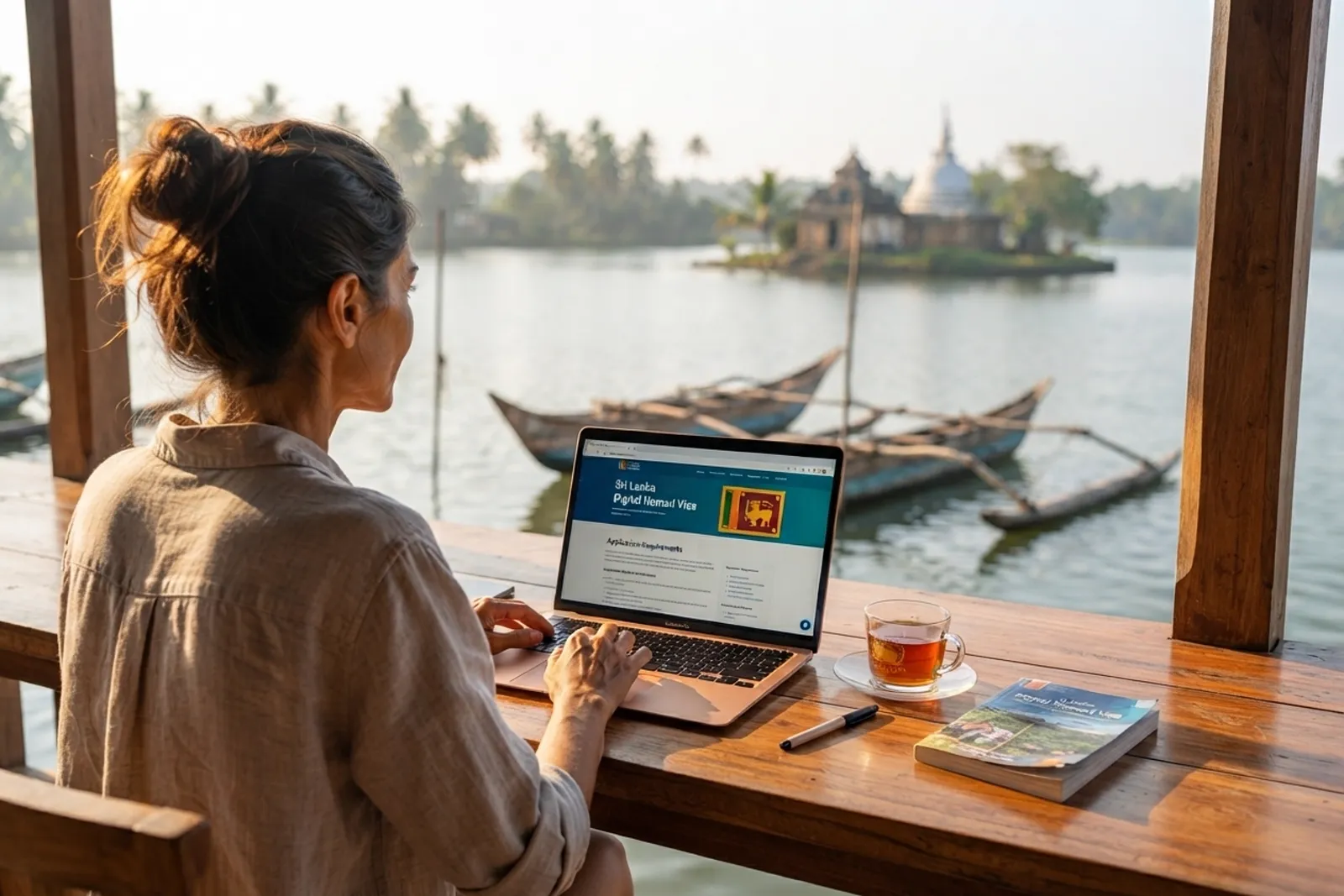
Sri Lanka's Digital Nomad Visa, launched in February 2026, requires a minimum remote income of USD 2,000/month, a USD 500/year fee per person, and — unlike the tourist ETA — a genuine immigration application with 12 supporting documents including a police clearance certificate and a medical clearance report. It's not a quick online form. It's a real residence visa, and it takes weeks, not minutes.
Sri Lanka introduced the Digital Nomad Visa (DNV) in February 2026, aimed at remote workers, freelancers, and business owners who serve clients or employers outside the country. It grants legal residence for up to 12 months, renewable annually, with the right to open a local bank account, sign a rental lease, and enrol dependent children in school — things a standard 30-day tourist ETA doesn’t allow.
Local employment inside Sri Lanka is explicitly not permitted under this visa — the entire point is income earned elsewhere, remitted in.
A lower income threshold (USD 1,500) and a 5-year visa option have both circulated online — neither appears in the official Digital Nomad Visa Category document from the Department of Immigration. The verified threshold is USD 2,000/month and the verified duration is one year, renewable. Treat any lower figure or multi-year claim as unconfirmed until an official source says otherwise.
This is the part that surprises people expecting an ETA-style process. Every applicant needs:
The police clearance certificate and the Ministry of Digital Economy recommendation are the two most likely to slow you down — both typically require lead time to obtain from outside Sri Lanka, so start those first if you’re planning around a specific arrival date.
| Applicant | Fee |
|---|---|
| Main applicant | USD 500/year |
| Spouse | USD 500/year |
| Each dependent | USD 500/year |
A family of three (two adults, one child) pays USD 1,500/year in visa fees alone, on top of the income requirement.
Renewing the visa beyond its first year requires proof of tax registration with Sri Lanka’s Inland Revenue Department — this is a mandatory condition of renewal, regardless of where your income is actually taxed. Registration and tax liability are two different things, though: Sri Lanka generally taxes residents on worldwide income and non-residents only on Sri Lankan-sourced income, and foreign-sourced remote income typically isn’t taxed locally under the DNV framework. Where you land depends on your specific residency status, how long you stay, and any tax treaty between Sri Lanka and your home country — this is genuinely worth a session with an accountant who handles cross-border cases before you rely on any blanket answer, including this one.
Colombo has the country’s best and most consistent internet — average fixed broadband around 50 Mbps download in the city, fiber connections standard in coworking spaces and hotels, and wide 5G coverage. It’s the safest bet if your work genuinely can’t tolerate an outage.
Ella has the strongest café culture for remote work and a well-established mountain-town nomad scene, but the infrastructure is looser — plenty of people work from a guesthouse balcony on a 4G hotspot rather than a dedicated coworking desk.
Weligama, on the south coast, has quietly become one of the more nomad-friendly bases outside Colombo — a real mix of coworking spaces and surf culture, close enough to Ahangama’s wellness scene next door that it’s realistic to build a week around both work and an actual practice, not just a laptop on a beach chair.
A full day at a coworking space runs roughly USD 5–20; monthly memberships in Colombo start around USD 82. All-in, a realistic monthly cost of living for a remote worker in Sri Lanka lands close to USD 1,300–1,400, before rent varies by city and standard.
A remote-work base and an actual reset aren’t mutually exclusive, and treating them as separate trips is usually a mistake — the whole appeal of basing yourself somewhere for months is that you don’t have to choose. If you’re weighing where to settle for a stretch, it’s worth looking at what a real wellness retreat in Sri Lanka actually involves before you commit to a city purely on internet speed — a week or two built around an actual practice, early on, tends to set the tone for the rest of the stay. If you’d rather start with a day than a week, browse experiences on the south coast near the nomad bases.
If your work can survive a slower connection a few days a month, don't default to Colombo just because the internet numbers look best on paper — the difference between working from a city and working from a coastal town with a real routine around it is bigger than a Mbps figure captures. Sri Lanka's broadband ranking (131st globally) sounds worse than what you'll actually experience in any of the towns above; the ranking is dragged down by rural areas most nomads never visit.