Sri Lanka's east coast point break, spot by spot — swell, wind and bottom detail, real costs, and exactly when to book for the May–September season.
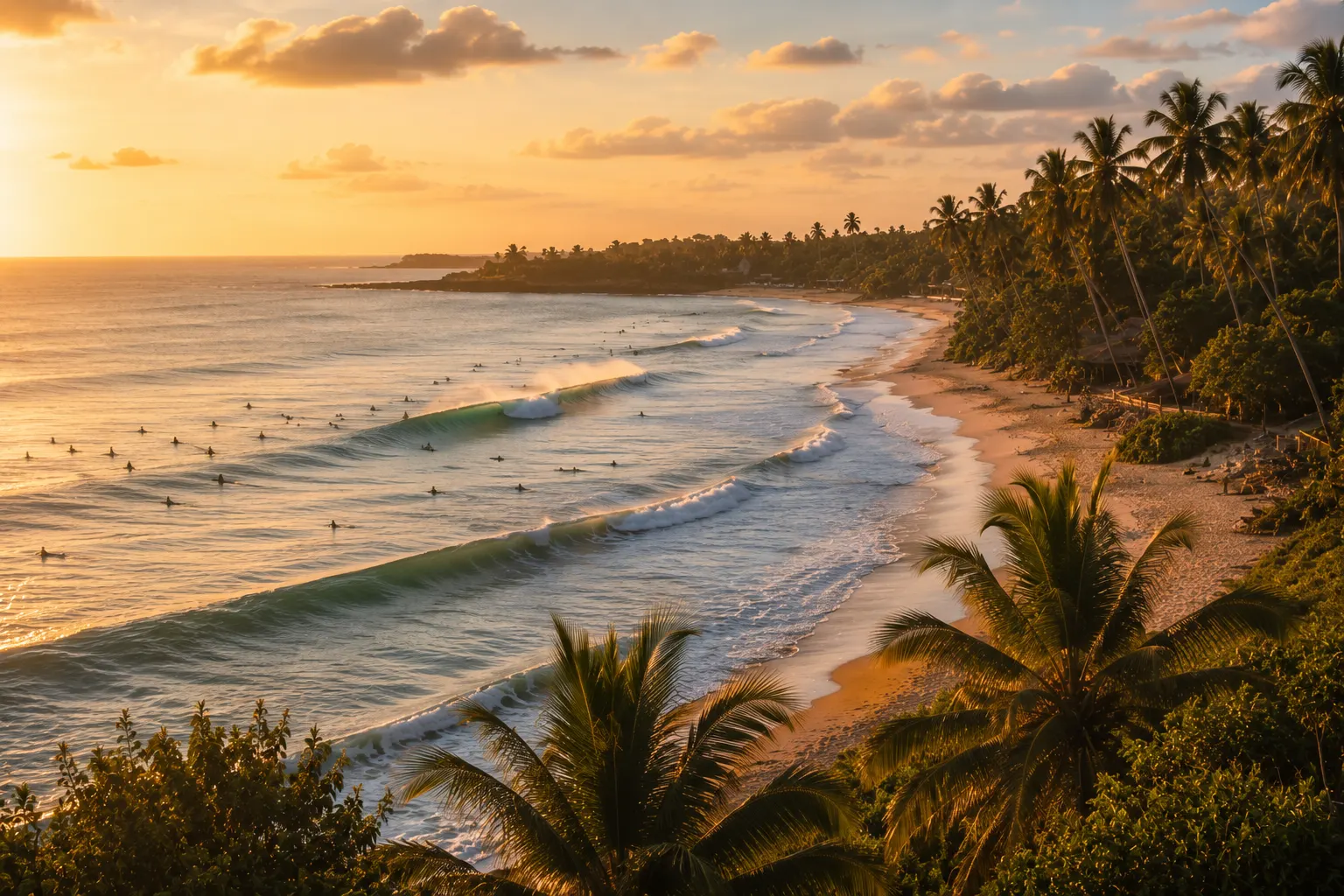
Arugam Bay is built around Main Point, a long right-hand break running up to 500 meters across three sections, with genuine competitive event history — an intermediate-to-advanced wave, not a beginner one. Around it: a gentler beach break at the north end of the bay and Whisky Point further north are both realistic options if you're newer to surfing, and quieter breaks like Pottuvil Point, Peanut Farm and Elephant Rock sit a short tuk-tuk ride away. The whole town runs on one season, May through September, peaking June to August — the exact opposite of the south coast's.
Arugam Bay isn’t one wave — it’s five or six genuinely different breaks packed into a small stretch of coast, all running on the same season, and knowing which one actually matches your level before you arrive changes the trip. This goes break by break, with the swell, wind and bottom detail that decides whether a given day is worth paddling out for.
Main Point is a long right-hand point break running up to 500 meters on a good day, across three distinct sections — the wave responsible for Arugam Bay’s genuine international surf reputation, with real competitive event history behind it, not just local hype. It works best with south-to-southeast swell and offshore wind from the northwest through north, over a bottom that’s partly coral and partly rock, which is exactly why timing your entry and exit matters as much as catching the wave itself. It’s an intermediate-to-advanced wave: fast, powerful, and unforgiving of surfers who aren’t ready for a point break of this length and pace. If Main Point is the reason you’re coming to Arugam Bay specifically, real experience on faster, more technical waves elsewhere makes the difference between riding it and getting worked by it.

Arugam Bay isn’t purely an advanced-surfers town, even though Main Point’s reputation suggests otherwise. The beach break at the bay’s northern end is a genuinely gentler wave, with several surf schools running lessons directly on the sand — a realistic option for first-timers who still want to be based in Arugam Bay rather than routing to the south coast instead. Baby Point, sitting right beside Main Point itself, is a soft, mellow right that lets newer surfers watch and learn from the main break’s rhythm without being anywhere near its actual power. Whisky Point, a short ride north of Main Point, is faster than the beach break but still intermediate-friendly, and carries noticeably fewer crowds than the main break — a good next step once you’ve got some whitewater experience behind you and want to progress without jumping straight into Main Point’s pace.
Pottuvil Point, a little further out from the main town stretch, offers a long right nearly as good as Main Point itself, with a fraction of the crowd — worth the extra ride for anyone who’d rather trade a few minutes of travel for a much emptier lineup. Closer to town, a short tuk-tuk ride south, Peanut Farm and Elephant Rock break over sand and rock rather than the reef and coral further north, giving a playful, more scenic session with meaningfully fewer people in the water. Elephant Rock specifically works best with east-southeast swell and offshore wind from the northwest, and rewards the short walk through the dunes to reach it with a noticeably quieter lineup than anything clustered around Main Point.
Because Main Point and Elephant Rock both break partly over rock, reef shoes and a realistic sense of your own level matter more here than at the sandy beach break — a mistake at low tide on the reef carries real consequences a beach break simply doesn’t.
The whole town runs on one season: May through September, driven by the northeast monsoon’s offshore winds and clean swells — the exact opposite window from the south coast’s November-to-April season. Within that:
Board rental is standard at every school in town and rarely a separate negotiation — most lesson packages bundle it in. A week-long structured surf program with coaching, board and accommodation runs in a similar range to the south coast’s camps, typically somewhere in the €600-750 bracket depending on how central the accommodation sits relative to Main Point. Before booking a lesson package specifically, it’s worth asking how many students share one instructor in the water — a lower ratio matters more to real progress in the first few sessions than anything in a school’s marketing photos.
Arugam Bay sits roughly 7 hours from Colombo by private driver (around 310km via Monaragala or Wellawaya), or a similar 7-8 hours by bus with a change at Batticaloa — many travelers instead route via Ella, about 3 hours away, folding it into a hill-country-to-coast trip rather than a direct Colombo transfer. Once there, the village itself is compact enough to cover by tuk-tuk or a rented scooter (roughly LKR 2,000-3,500/day, license required) — ATMs are limited to Pottuvil town, 5km away, so carrying extra cash matters more here than on the south coast.
Arugam Bay’s identity is built around surfing, but there’s a real slower-travel side worth knowing about. Kumana National Park, about an hour away, is the east coast’s quieter answer to Yala — strong leopard and elephant populations, excellent birdwatching (peaking June-July for migratory species), and a fraction of Yala’s jeep traffic. Pottuvil Lagoon runs mangrove boat tours with regular crocodile and kingfisher sightings. And wild elephants frequently cross the road between Arugam Bay and Pottuvil at dusk during the surf season, an easy sighting with a driver who knows the timing.
Arugam Bay is the right call if you’re an intermediate-to-advanced surfer specifically chasing Main Point’s reputation, or if your travel dates simply fall in the south coast’s off-season and you want a genuine seasonal counterpart. It’s a less natural fit if you’re a total beginner hoping to avoid any surf crowd at all — the beach break works, but the town still draws a committed surf crowd overall — or if a quiet, retreat-focused wellness trip is the priority over the wave itself; the south coast towns are the stronger fit for that. The complete surfing in Sri Lanka guide covers both coasts side by side if you’re still deciding between them.
Ready to see what’s actually bookable on this coast? Every real surf camp and lesson listed on lankaspirit is organized by coast and season, Arugam Bay included.
Main Point earns the reputation, but treating it as the only wave in town sets the wrong expectation for anyone who isn't already surfing at that level. The beach break and Whisky Point exist specifically because not everyone showing up is chasing a 500-meter point break, and matching your own level to the right break here — rather than defaulting to the famous one — is what actually decides whether the trip works.